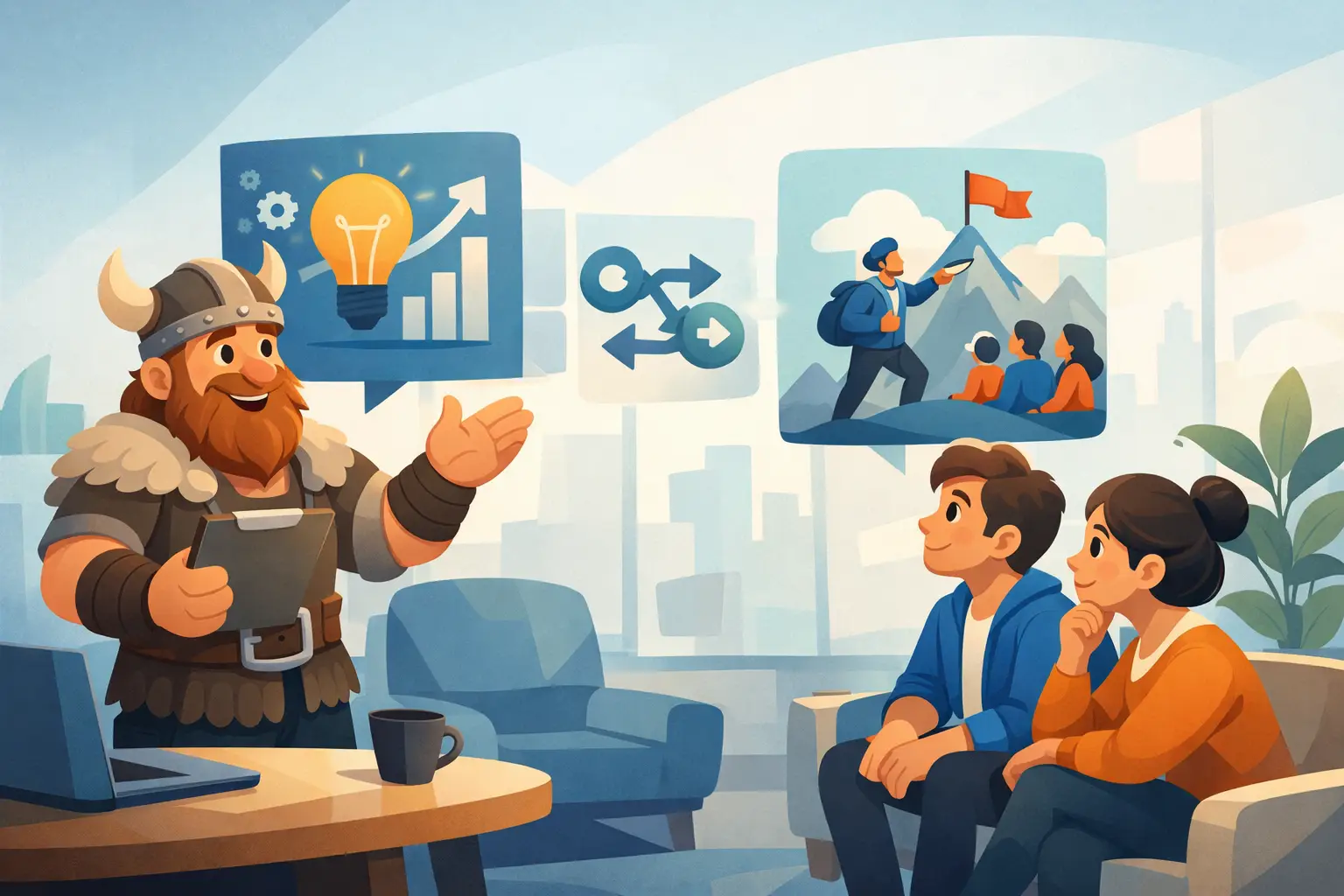
Most founders do not need another theory-heavy course on artificial intelligence. They need help pricing better, improving follow-ups, spotting cash flow issues earlier, tightening operations, and making faster decisions with less second-guessing. That is where AI business training becomes commercially useful – not as a lesson in jargon, but as a practical way to build, grow, and scale with more confidence.
For small business owners and lean teams, the real question is not whether AI matters. It is whether it can help this week. Can it sharpen your sales process, reduce admin, support hiring decisions, or give structure to strategic planning when time is tight and pressure is high? Good training should answer that clearly. If it does not lead to better decisions and stronger execution, it is just more noise.
What AI business training should actually do
The best AI business training does not start with tools. It starts with business problems. A founder rarely wakes up thinking, we need a new prompt framework. They wake up thinking, our pipeline is inconsistent, our team is stretched, margins are under pressure, and we need to move faster without making poor calls.
That is why practical training has to sit at the intersection of strategy and execution. It should help a business understand where AI can remove bottlenecks, where human judgement still matters most, and how to use both together. In reality, that often means teaching teams how to ask better questions, evaluate outputs properly, and turn ideas into repeatable workflows.
There is a big difference between showing someone how an AI assistant works and training them to use AI to improve commercial performance. The first is product knowledge. The second is business capability.
Why generic AI training often falls short
A lot of AI education is still built for broad audiences. It covers concepts, trends, and flashy examples, but leaves business leaders with a familiar problem: they understand the headlines yet still do not know what to do next.
For a lean company, that gap matters. If you are running a business with limited headcount, every hour spent learning something new needs a likely return. Training that focuses too heavily on technical detail can be interesting, but it will not always help a founder decide how to improve lead qualification, manage workload, or pressure-test a plan before committing budget.
The other issue is fragmentation. Marketing gets one tool. Sales trials another. Finance experiments with something separate. HR has no idea what anyone else is using. Suddenly AI is in the business, but not working as a business system. That creates inconsistency, duplicated effort, and avoidable risk.
Effective training needs to reflect how companies actually operate. Decisions in one area affect another. A pricing change influences sales. A hiring plan affects cash flow. A marketing campaign changes operational demand. AI support makes far more sense when it is taught in that wider context.
AI business training for founders and lean teams
For founders, the value of AI business training is clarity. It helps turn vague interest into specific use cases, and specific use cases into action. Instead of asking, how do we use AI, the question becomes, where will AI save time, improve quality, or strengthen decisions first?
Usually, the best starting point is not the most advanced use case. It is the most repeated one. Think proposal drafting, sales follow-up sequences, customer research summaries, meeting notes, competitor analysis, pricing reviews, process documentation, or first-pass business planning. These are the areas where teams often lose time and momentum.
A useful training approach shows people how to build reliable habits around this work. That means knowing when to use AI for speed, when to use it for structure, and when to slow down and apply human judgement. If the output affects money, people, legal exposure, or brand trust, review matters. AI can accelerate thinking, but it should not replace accountability.
This is especially important for growing firms without in-house specialists across every function. One of the biggest commercial advantages of AI is that it can widen access to structured expertise. Used well, it gives smaller teams a stronger starting point in areas where they may not have deep experience.
What good training looks like in practice
The strongest programmes are grounded in real operating challenges. They do not just explain what AI can do. They show teams how to use it inside the flow of running a business.
That might mean training a founder to turn rough business goals into a 90-day action plan. It might mean helping a sales lead use AI to refine objections handling and follow-up messages without sounding robotic. It could involve supporting an operations manager to document recurring tasks, identify delays, and create cleaner internal processes.
Good training also teaches judgement. AI can generate options quickly, but speed can create false confidence. Teams need to know how to sense-check recommendations, test assumptions, and spot weak outputs before they become business decisions. That layer is often what separates productive AI use from expensive mistakes.
There is also a cultural element. If AI training feels threatening, adoption will stall. If it feels practical and supportive, teams are far more likely to engage. The aim is not to replace capable people. It is to give them better support, reduce low-value effort, and help them focus on work that moves the business forward.
The areas where AI can create the fastest return
For most small businesses, the quickest wins tend to come from work that is repetitive, text-heavy, research-led, or slowed down by decision bottlenecks. Sales and marketing are common starting points because improvements are visible quickly. Faster content production, more consistent outreach, clearer messaging, and stronger proposal support can all have a near-term impact.
Operations is another strong candidate. Many growing businesses run on informal processes that live in someone’s head or in scattered documents. AI can help capture, structure, and improve those workflows. That reduces friction and makes growth easier to manage.
Strategy and planning are often overlooked, but they matter just as much. Founders spend a lot of time thinking through trade-offs without always having a sounding board. AI can help frame decisions, compare options, and bring more discipline to planning. It is not a substitute for experience, but it can be a very useful layer of support.
Finance and HR can benefit too, although the tolerance for errors is lower. In these areas, training should be more careful. AI can support analysis, drafting, and scenario thinking, but final decisions need tighter oversight. That is where the phrase it depends really matters. The right level of AI use changes according to the risk involved.
How to choose the right AI business training
If you are evaluating options, start by asking a simple question: will this help my team perform better in their actual roles? If the answer is vague, keep looking.
Training should be tied to outcomes. Better decisions. Faster execution. Clearer planning. More consistent processes. Stronger commercial focus. It should also reflect the maturity of the business. A start-up founder juggling everything needs something different from a twenty-person team trying to standardise how departments work.
Look for relevance over hype. The right provider should be able to connect AI to sales, marketing, finance, operations, and strategy in a way that feels joined up. That cross-functional view matters because most business problems are not isolated. They spill across teams.
It also helps if the support goes beyond one-off learning. Businesses change quickly. New priorities emerge. Teams need advice that can evolve with them. That is one reason platforms such as Any Guru are gaining traction. Instead of offering generic chat or static training, they combine coaching-style guidance with practical tools and action plans that help businesses apply AI to live commercial challenges.
The real opportunity
AI business training is not about turning every founder into a technical specialist. It is about helping more businesses think clearly, act faster, and make stronger decisions with the resources they already have.
For ambitious teams, that matters. Growth rarely stalls because people lack effort. It stalls because decisions pile up, expertise is fragmented, and execution gets messy. Good AI training reduces that drag. It gives people a sharper way to plan, prioritise, and follow through.
The businesses that benefit most will not necessarily be the ones chasing every new tool. They will be the ones using AI with purpose, building practical habits around it, and treating it as a support system for better business judgement. Start there, and AI stops being a trend to keep up with. It becomes part of how you move faster and scale with confidence.